

What is Pearl Harbor?
Pearl Harbor refers both to a U.S. naval base in Hawaii and the infamous surprise attack by Japan on December 7, 1941. Pearl Harbor is located on the island of Oahu, Hawaii, on the southern coast of the island. It was officially designated a naval base in 1908 and has been an important area for US military operations. When Japan attacked Pearl Harbor in December of 1941 this started the United States’ involvement in the second World War. But why did Japan attack and what happened after they attacked?
Before Pearl Harbor
Before the attack on Pearl Harbor, many Americans joined the military due to a growing sense of necessity because of the actions of Germany and Japan. At first the majority of Americans were against joining the war, but after Germany’s takeovers in Europe and Japan’s aggression in East Asia, the public’s opinion started shifting. The public started wanting to intervene in the war. Then the passage of the first peacetime draft in September of 1940 greatly expanded the military. This action required that military service enrolled millions of men into the armed forces, though many men also volunteered. There was also a sense of patriotic duty before America even entered the war, where people felt that it was their duty to help protect the nation and its allies. The American people and government also felt that war was inevitable as the global conflict escalated. This led to some enlistment in anticipation of a future conflict.
During the 1930s, Japan wanted to expand their empire on the Pacific Rim. In 1931, Japan took over the Manchuria region of China. Over the next six years sporadic fighting between Japan and China occurred. Then a full-fledged war known as the second Sino-Japanese War began in July of 1937, when Japan invaded China and captured the capital city, Nanjing. Simultaneously, Japan began to align itself with Nazi Germany and Fascist Italy and expanded its military forces. In November of 1936, Japan and Germany signed the Anit-Comintern Pact, which created an alliance against the Soviet Union. Then another pact was signed in September of 1940, where Germany, Italy, and Japan signed the Tripartite Pact. This pact constructed the alliance between the three countries known as the Axis powers. Japan’s expansion into China was widely censured in the United States and other countries. President Franklin D. Roosevelt feared that Japan would advance into Hong Kong, southeast Asia, and the Philippines, which at the time was a US territory. The US government offered to provide China with aircraft and monetary loans in 1940. Over the next year, tensions between the United States and Japan increased. Roosevelt’s government even passed economic sanctions against Japan and expanded the Lend-Lease program that gave military aid to China.

The Attack
The US sanctions and policies became increasingly aggressive, Japan became determined to attack the United States. Japanese military leaders called for a surprise attack to destroy the entire US Pacific Fleet at Pearl Harbor. If it impaired the US naval power in the Pacific, then the Japanese military assumed that the US would be unfit to intervene with Japan’s territorial conquest.
On November 26, 1941, a large naval force with six aircraft carriers that held over 400 planes set sail from Japan. The force operated under unbroken radio silence and avoided shipping lanes to escape observation. The Japanese ships had traveled around 3,000 miles to a spot some 230 miles north of Oahu. This was where the attack on Pearl Harbor would be launched.
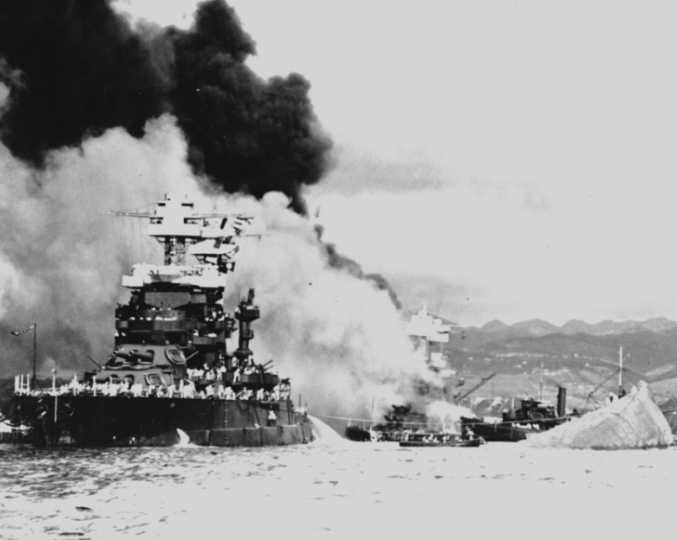
At 7:55 a.m. (Hawaii time) on Sunday, December 7, 1941, was when the first two waves of the Japanese naval aircraft attacked Pearl Harbor. The US forces were caught by surprise, as this was early in the morning and they were not prepared for an aircraft attack. Bombs and bullets rained down on the ships that were anchored below. At 8:10, a 1,800-pound bomb crashed through the deck of the USS Arizona, a battleship. The ship then exploded and sank with over 1,000 men trapped inside. Then, torpedoes punctured the outer shell of the battleship USS Oklahoma. The ship had 400 sailors aboard, the ship lost its balance, rolled onto its side and slipped underwater. Not even two hours later, the surprise attack was over, and every battleship in Pearl Harbor; USS Arizona, USS Oklahoma, USS California, USS West Virginia, USS Utah, USS Maryland, USS Pennsylvania, USS Tennessee, and USS Nevada had sustained extreme damage.
Pearl Harbor was also not the only target they attacked that day. Japanese forces struck multiple US territories in the Pacific, including the Philippines, Guam, Midway Island, and Wake Island. They also attacked the British territories of Malaya, Singapore, and Hong Kong. Within the following week, Japan controlled all of these territories.
Impact of the Pearl Harbor Attack
The Japanese attack on Pearl Harbor impaired or destroyed nearly 20 American ships and more than 300 airplanes. Dry docks and airfields were destroyed. But most importantly, the Attack on Pearl Harbor killed 2,403 U.S. personnel, including sailors, soldiers and civilians. 1,178 people were also wounded and 129 Japanese soldiers were killed. Half the people who died at Pearl Harbor were on the USS Arizona.
The Japanese had failed to disable the Pacific Fleet. By the 1940s, battleships were no longer the most important naval ships: Aircraft carriers were, by coincidence, all of the Pacific Fleet’s carriers were away from the base on December 7. Some had returned to the mainland and others were delivering planes to troops on Midway and Wake Islands. The Pearl Harbor attack also left the base’s most important onshore facilities (oil storage depots, repair shops, shipyards and submarine docks) intact. Because of this, the U.S. Navy was able to rebound relatively quickly from the attack.
As stated earlier, the majority of Americans were reluctant to have the United States enter the war. But Pearl Harbor changed that. On December 8, the day after the attack of Pearl Harbor, President Franklin D. Roosevelt addressed a joint session of the U.S. Congress. The US Congress declared war on Japan. President Roosevelt signed the declaration of war hours later. In an address to the American people, he said, “We are now in this war. We are all in it – all the way. Every single man, woman, and child is a partner in the most tremendous undertaking of our American history.”
Germany’s Chancellor Adolf Hitler declared war on the United States on December 11, 1941. He cited parts from the 1940 Tripartite Pact. The part stated that Germany, Japan, and Italy would “assist one another with all political, economic and military means when one of the three contracting powers is attacked by a power at present not involved in the European war or in the Chinese-Japanese conflict.” In his declaration of war against the United States, Hitler expressed Germany’s “deep appreciation” to the Japanese government for attacking Pearl Harbor. He also cited long-standing antisemitic conspiracy theories that incorrectly claimed that President Roosevelt was controlled by Jewish people. Additionally, Hitler said that war had been “forced” upon Germany by the United States and Great Britain. He seemed to have ignored that Germany and Japan were instigators in the war.
In the days after the attack, World War II had changed. The United States had joined the Allied powers (United States, the Soviet Union, the United Kingdom, and China) in the war against the Axis powers (Germany, Italy, and Japan).



Roberta Ziegler • Jan 3, 2026 at 12:19 pm
Very informative and well written!
adviser • Jan 12, 2026 at 11:51 am
We thought so too!